
AI Readiness Assessment for hublms.com
Overall Impression
The site is essentially a ghost town of empty claims, suffering from a chronic lack of verifiable evidence and machine-readable metadata across every single page. While the visual design effectively mimics the HubSpot ecosystem, the total absence of social proof, ROI data, and schema markup makes the brand appear untrustworthy to human buyers and invisible to AI agents. It functions as a basic feature brochure rather than a high-performance B2B conversion engine, failing to mitigate buyer risk at every turn.
Overall Strengths
- Consistent use of high-impact, direct H1 headings that immediately communicate the core value proposition.
- Clean UI design that successfully aligns with the HubSpot native environment, reducing cognitive load for the target audience.
- High transparency regarding pricing tiers and technical requirements, avoiding the 'hidden cost' trap.
- Functional and prominent calls-to-action (CTAs) consistently placed throughout the user journey.
Weaknesses & Gaps
- Total site-wide absence of social proof, including customer testimonials, case studies, and client logos.
- Systemic failure to implement Schema.org markup (Organization, Product, FAQPage), leaving the site structurally deficient for modern SEO.
- Zero display of critical trust signals such as security certifications (SOC2, ISO) or official HubSpot partner tier status.
- Lack of quantifiable ROI metrics or performance data to provide logical leverage for B2B decision-makers.
- Absence of a searchable technical knowledge base or API documentation for deeper product validation.
Recommendations
- Deploy site-wide JSON-LD schema immediately, prioritizing Organization, Product, and FAQPage types to improve machine-readability.
- Integrate a 'Proof' section on every high-traffic page featuring at least three customer testimonials with names and headshots.
- Embed a 'Trust Bar' in the footer containing SOC2/ISO compliance icons and official HubSpot Partner badges.
- Develop a quantifiable ROI comparison table to show specific time or cost savings versus traditional LMS platforms.
- Drastically reduce friction on the 'Test Drive' form by removing non-essential fields to increase lead conversion rates.
- Create a centralized, searchable Knowledge Base to replace static FAQ lists and satisfy technical buyer scrutiny.
- Implement FAQ sections on all transactional pages (Pricing, Test-Drive, Demo) to proactively address common buyer objections.
Ready for the Full Picture?
This homepage analysis is just the beginning. Get a comprehensive AI Readiness Assessment covering up to 30 pages of your website and meet with a growth strategist to build your action plan.
Book Your Full AssessmentDetailed CLEAR Breakdown
Human Perspective Seeks social proof, authority (awards, partnerships), and a clear, jargon-free value proposition. They need to quickly understand your "Why, How, and What."
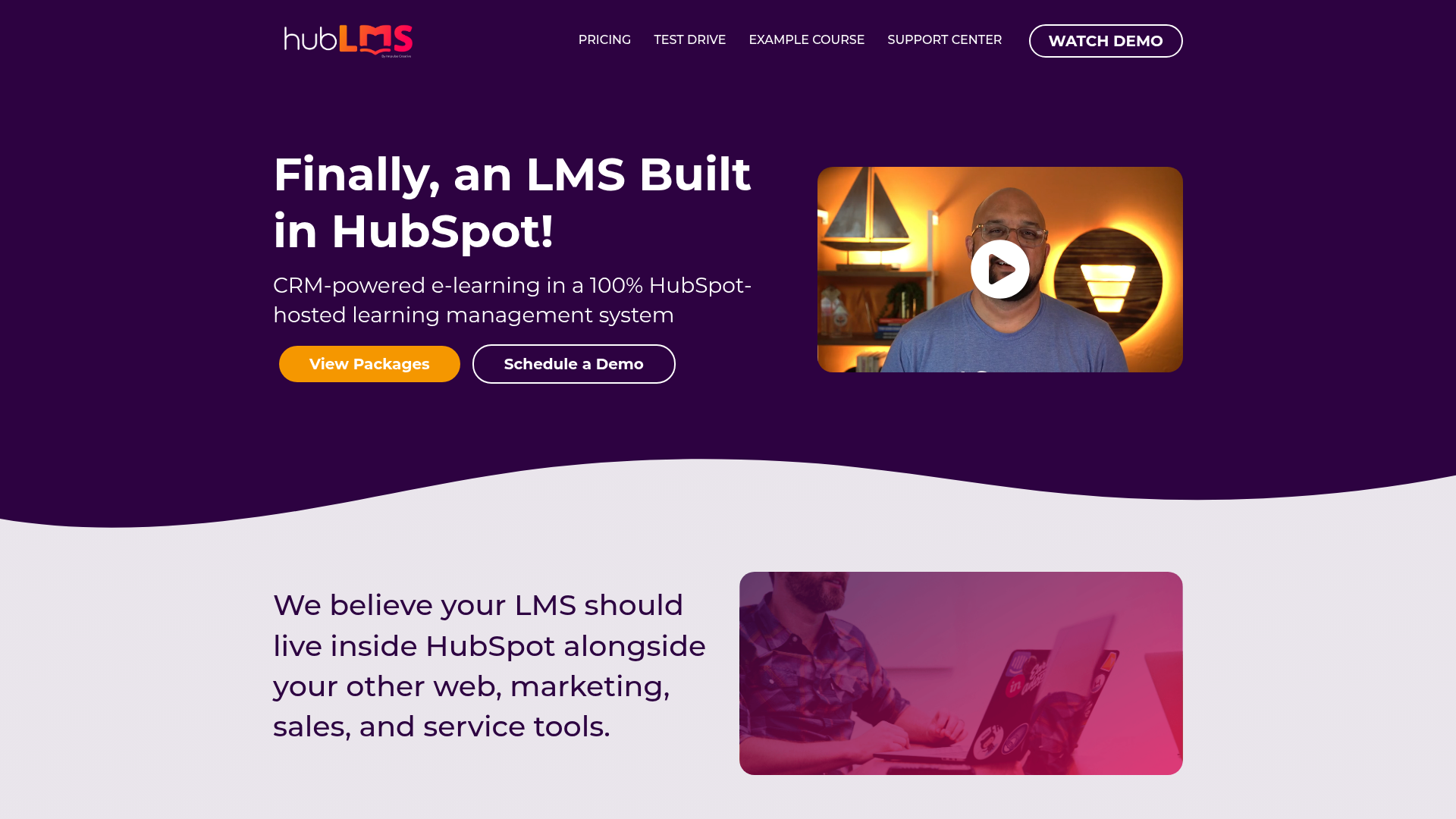
The value proposition is immediate and powerful: an LMS that lives inside HubSpot. This solves a major technical pain point. However, the page is nearly devoid of third-party credibility. There are no client logos, no analyst mentions, and no security certifications (SOC2, ISO) shown. The mention of Impulse Creative in the footer provides minimal weight for those unfamiliar with the agency. The 'Why' is addressed through the lens of convenience, but the vendor's own authority remains unproven.
AI Agent Perspective Processes verifiable data points: company age, structured data (schema), consistent terminology, and off-site mentions from reputable sources.
The page uses a clear H1 and H2 structure that defines the core offering early. However, there is no Organization or Product schema markup present in the HTML. The terminology is consistent, focusing on 'HubSpot CRM' and 'e-learning.' The title tag is functional, but the lack of structured data makes it difficult for an agent to verify credentials or official brand entities.
Human Perspective Looks for tangible benefits (ROI, efficiency) and a logical fit (integrations, implementation ease) that minimizes disruption.
The logic is sound: integration is hard, so buy a tool that requires zero integration. It maps features like 'Guided Learning' and 'Student Portal' to HubSpot tools the buyer already uses. What is missing is any quantifiable ROI or performance data. There are no stats on time saved or student completion rates. The solution explains the 'How' (using HubSpot CMS/CRM) but fails to prove the 'Logic' of its impact with data.
AI Agent Perspective Extracts quantifiable results from case studies and analyzes technical documentation for specifications, APIs, and compatibility requirements.
Features are organized into distinct H4 blocks and paragraphs, making them extractable. However, there are no technical tables, spec sheets, or Product schema containing feature/benefit attributes. The technical feasibility is mentioned via 'Stripe Checkout' and 'SSO,' but these are not linked to documentation or structured lists.
Human Perspective Needs proof (case studies, testimonials) but is also influenced by emotion—the company's story, values, and purpose (the "Why").
This is a major failure point. The page has zero testimonials, zero case studies, and zero user-generated content. The emotional hook is a generic promise to 'dazzle your students,' which lacks authenticity without a human face or voice behind it. There is no evidence that anyone has actually used this successfully.
AI Agent Perspective Prioritizes verifiable evidence from data sheets and reports. Can perform sentiment analysis on reviews but doesn't "feel" emotion.
There is no Review or Rating schema markup. No links to external white papers or text-searchable data sheets were found. Anchor text for internal links is mostly generic buttons. Sentiment keywords are present ('love,' 'dazzle') but are not supported by any extractable proof points.
Human Perspective Assesses if the company's vision and roadmap align with their long-term goals. Needs easy access to support info (SLAs, training).
A link to a 'Support Center' and an 'Example Course' provides some sense of the Delivery phase. However, there is no FAQ section, no mention of a product roadmap, and no description of customer success or implementation support. It feels like a one-off purchase rather than a long-term partnership.
AI Agent Perspective Looks for structured information on support plans, links to knowledge bases, and keywords related to future development.
While there is a link to a support center, there is no FAQ schema. No SLAs or support tiers are documented in a parseable format. The page does not use breadcrumbs or a structure that signals partnership longevity to a machine.
Human Perspective Values prompt, personalized responses and content that is highly relevant to their industry, role, and specific pain points.
CTAs are prominent and clear ('View Packages,' 'Schedule a Demo'). The content is highly relevant to HubSpot users, which is a specific, well-defined audience. However, there is no audience segmentation on the page (e.g., 'For Healthcare,' 'For SaaS') and no live chat/interactive element present in the static HTML provided.
AI Agent Perspective Evaluates the availability of contact methods and assesses relevance based on content segmentation, tagging, and keywords.
The URL structure and content are not segmented by industry or role. ContactPoint schema is absent. The calls to action are identifiable as buttons but lack descriptive metadata for an agent to determine the expected outcome of a 'Demo' vs 'Pricing' beyond the link itself.