
Page Assessment for
https://impulsecreative.com/ai-policy
Overall Impression
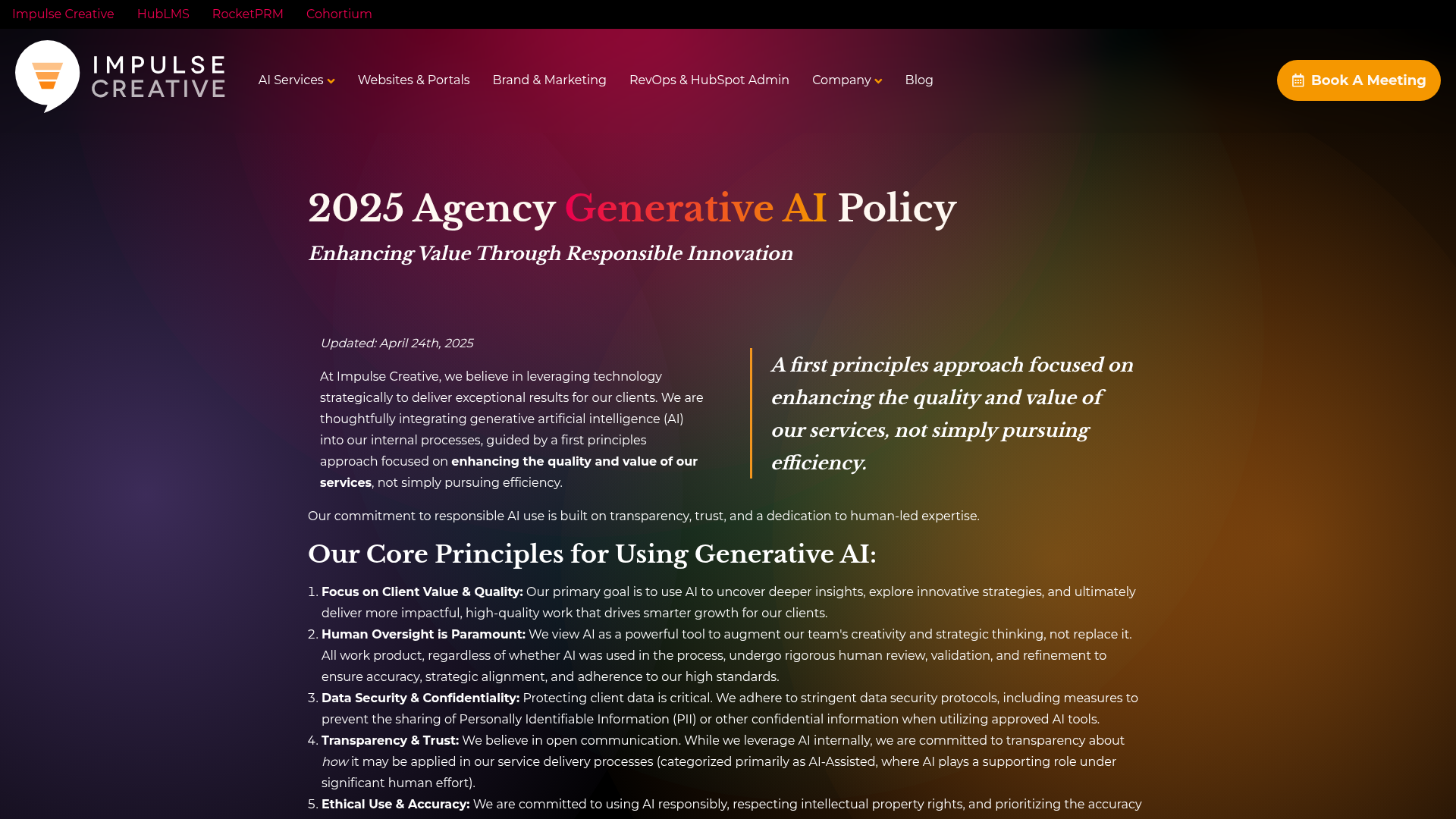
This is a defensive, compliant document masquerading as a marketing page. While it successfully defines the agency's ethical boundaries, it fails to provide any evidence of capability or results.
Overall Strengths
- Clear, dated policy update
- Differentiated definitions of AI-Assisted vs AI-Generated
- Quantifiable 25% threshold for AI usage
- Presence of Organization schema
Weaknesses & Gaps
- Zero testimonials or case studies
- No FAQ section or FAQ schema
- Missing ContactPoint schema
- Lack of third-party certifications or trust badges
- No audience segmentation by industry or role
- No links to verifiable external sources for credentials
Recommendations
- Embed a case study showing the 'before/after' of an AI-assisted project to provide Evidence.
- Add FAQ schema and a visible FAQ section to address common client fears regarding AI data privacy.
- Implement ContactPoint schema for the phone and support links in the footer.
- Include a table of approved AI tools and their specific data security status (e.g., SOC2 compliant) to improve Leverage and Logic.
Ready for the Full Picture?
This single-page analysis is just one piece of the puzzle. Get a comprehensive AI Readiness Assessment covering up to 30 pages and meet with a growth strategist to build your action plan.
Book Your Full AssessmentDetailed CLEAR Breakdown
Human Buyer Seeks social proof, authority (awards, partnerships), and a clear, jargon-free value proposition.
The page establishes basic credibility through a professional design and a clear, dated policy update (April 24, 2025). The language is jargon-free and the 'First Principles' approach is understandable. However, it lacks external validation markers like ISO certifications, SOC 2 compliance, or analyst recognition that would elevate trust for a Decision-stage page. The value proposition is focused on safety rather than performance.
AI Agent Processes verifiable data points: structured data (schema), consistent terminology, and off-site mentions from reputable sources.
The HTML provides a clear H1 and logical H3 subheadings. Organization schema is present in the head, which is a strength. Terminology like 'AI-Assisted' and 'AI-Generated' is used consistently. However, there is no specific 'CreativeWork' or 'Service' schema to define the policy itself, and the page lacks links to verifiable external credentials.
Human Buyer Looks for tangible benefits (ROI, efficiency) and a logical fit (integrations, implementation ease).
The logic is sound, particularly the distinction between AI-Assisted and AI-Generated content. The 25% threshold for AI contribution is a rare quantifiable claim that provides a concrete boundary for the reader. It fails to provide ROI data or specific use cases that would demonstrate the logic of *how* AI improves client outcomes beyond just 'efficiency'.
AI Agent Extracts quantifiable results from case studies and analyzes technical documentation for APIs and compatibility.
The core principles are presented in a clean ordered list, making them easily extractable. The 'AI-Assisted' vs 'AI-Generated' definitions are well-structured for NLP parsing. It lacks a technical table of tools, API integrations, or structured data regarding the 'Operating Agreement' mentioned in the text.
Human Buyer Needs proof (case studies, testimonials) but is also influenced by story, values, and purpose.
This is a major failure point. There are zero testimonials, zero case studies showing AI-driven results, and zero third-party reports. While the 'human-led' messaging attempts to evoke trust, it lacks the emotional weight of real-world impact stories. Without proof, the policy feels like a legal shield rather than a competitive advantage.
AI Agent Prioritizes verifiable evidence from data sheets and reports. Can perform sentiment analysis but does not "feel" emotion.
There is zero Review or Rating schema. No links to external evidence files like PDFs or case study subpages are present in the main body. Testimonials are non-existent, leaving the agent with no sentiment-rich text to verify the agency's effectiveness in AI application.
Human Buyer Assesses if the company's vision aligns with their long-term goals. Needs easy access to support info (SLAs, training).
The page aligns with a 'partnership' vision by mentioning a collaborative Operating Agreement and a commitment to transparency. However, it is missing an FAQ section, which is critical for a policy page. There is no mention of support tiers or a roadmap for how this policy will evolve as AI tech changes.
AI Agent Looks for structured support plans, knowledge base links, and keywords related to future development.
FAQ schema is missing. While the navigation menu is well-structured, the body content lacks structured data for support tiers or service-level agreements (SLAs). The commitment to continuous learning is stated as text but not backed by links to a knowledge base or training resources.
Human Buyer Values prompt, personalized responses and content relevant to their industry, role, and pain points.
The 'Book A Meeting' CTA is persistent and prominent, which is a strength. The policy is relevant to any modern marketing lead concerned about AI. However, the content is generic and not segmented by industry or role (e.g., specific AI implications for Healthcare vs. SaaS).
AI Agent Evaluates contact method availability and assesses relevance via content segmentation, tagging, and keywords.
Contact information is present in the footer but lacks ContactPoint schema markup. The URL structure is flat and does not reflect audience segmentation. There is zero tagging or metadata to help an AI agent identify which industry this AI policy is most relevant to.