
Page Assessment for
https://ieoffices.com/industry/public-sector/
Overall Impression
The page is a generic industry placeholder that identifies a problem using third-party stats but offers no proof that the company can solve it. It is structurally weak for both humans and AI due to a complete lack of evidence and structured data.
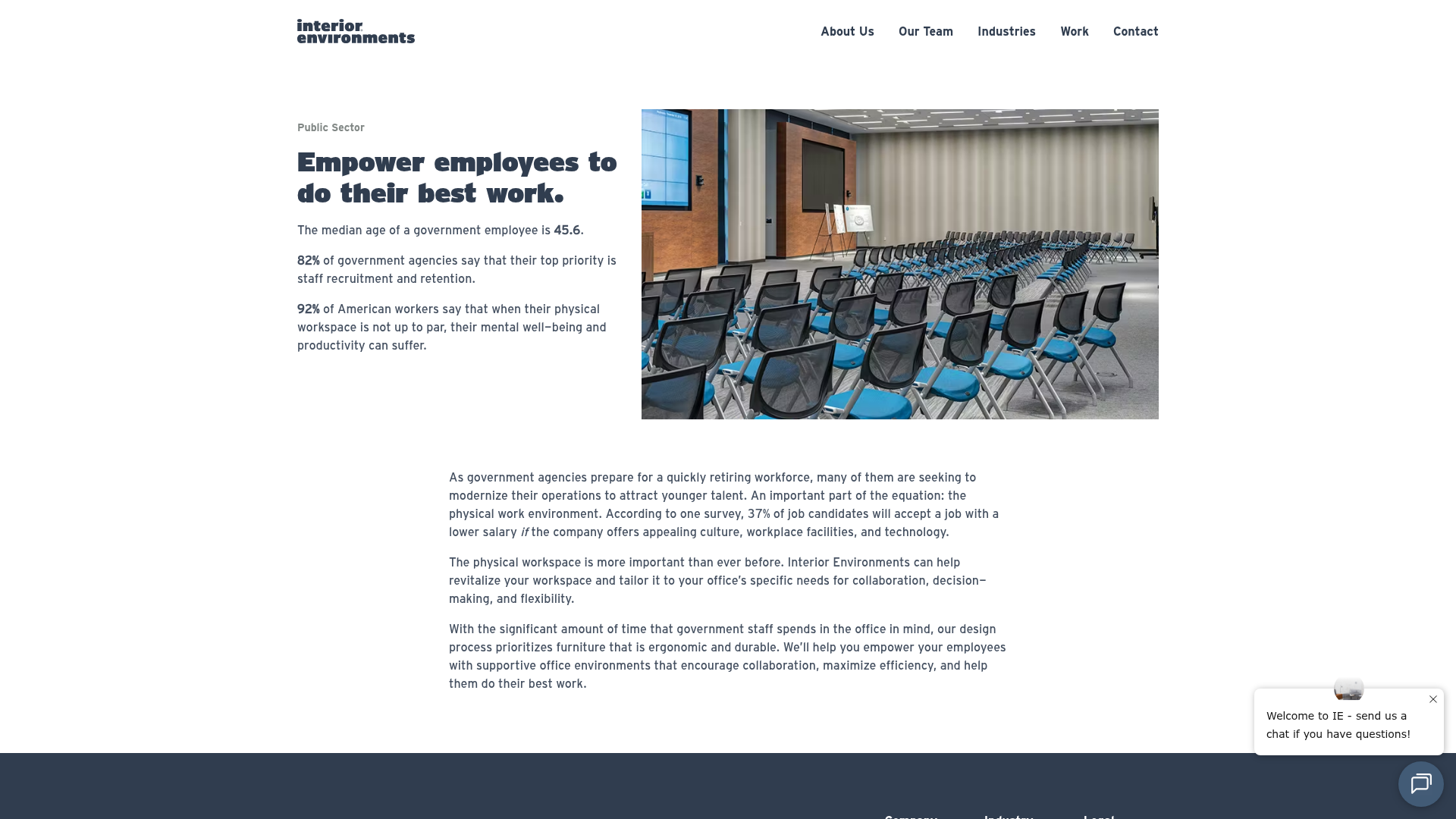
Overall Strengths
- Effective use of industry statistics to frame the challenges of the Public Sector.
- Clean, professional design and navigation structure.
- Clear audience segmentation in the URL and primary heading.
Weaknesses & Gaps
- Zero on-page case studies or client testimonials.
- Complete absence of Schema.org markup (Organization, Service, FAQ, or ContactPoint).
- No specific certifications or contract vehicles (e.g., GSA schedules) mentioned.
- Lack of quantifiable ROI or project-specific data.
- No FAQ section to address sector-specific procurement questions.
- Absence of a phone number for immediate human contact.
Recommendations
- Embed at least two public-sector-specific case studies with quantifiable outcomes and 'before/after' visual evidence.
- Implement comprehensive Schema.org markup, specifically Organization and Industry-specific Service types.
- Add a section detailing specific government contract vehicles or certifications to build immediate sector credibility.
- Create a Public Sector FAQ block with corresponding FAQ schema to address common procurement and implementation questions.
- Convert the general industry stats into a more extractable format like a table or a highlighted 'Fast Facts' list.
Ready for the Full Picture?
This single-page analysis is just one piece of the puzzle. Get a comprehensive AI Readiness Assessment covering up to 30 pages and meet with a growth strategist to build your action plan.
Book Your Full AssessmentDetailed CLEAR Breakdown
Human Buyer Seeks social proof, authority (awards, partnerships), and a clear, jargon-free value proposition.
The page clearly identifies its target as the Public Sector and uses professional language, but it fails to establish firm-specific credibility. There are no mentions of specific certifications, GSA schedules, or government-specific partnerships that would reassure a public sector buyer. The value proposition is a generic 'empower employees' statement that lacks a unique competitive edge.
AI Agent Processes verifiable data points: structured data (schema), consistent terminology, and off-site mentions from reputable sources.
Heading hierarchy is present (H6 to H2), and the core offering is identified early. However, there is zero Schema.org markup (Organization, Product, or Service) present in the provided HTML. The lack of verifiable credentials or linked analyst recognition makes it difficult for an agent to verify the entity's authority in this specific niche.
Human Buyer Looks for tangible benefits (ROI, efficiency) and a logical fit (integrations, implementation ease).
The page uses industry-wide statistics to create a logical 'Why' (aging workforce, retention issues), which is a good awareness-stage tactic. However, it fails to provide IE-specific logic or ROI data. There are no descriptions of specific furniture systems or technical workflows that explain 'How' they solve these public sector problems beyond a vague mention of 'ergonomic' furniture.
AI Agent Extracts quantifiable results from case studies and analyzes technical documentation for APIs and compatibility.
Benefits are listed in a structured text block, but they are not formatted as extractable lists or tables. There is no technical documentation, API info, or integration data available for processing. Without quantifiable IE-specific claims, the logic remains theoretical rather than data-driven for an agent.
Human Buyer Needs proof (case studies, testimonials) but is also influenced by story, values, and purpose.
This component is a total failure. There are zero case studies, zero client testimonials, and zero third-party reports on the page. While the industry stats evoke a sense of urgency regarding retention, there is no proof that Interior Environments has actually solved these problems for a single government agency. The 'Work' link in the nav is a generic catch-all and does not count as on-page evidence.
AI Agent Prioritizes verifiable evidence from data sheets and reports. Can perform sentiment analysis but does not "feel" emotion.
Zero Review or Rating schema markup. No case studies or data sheets are linked or labeled specifically for the public sector. There are no identifiable testimonial blocks for an agent to parse and attribute sentiment to.
Human Buyer Assesses if the company's vision aligns with their long-term goals. Needs easy access to support info (SLAs, training).
The page lacks any content regarding long-term support, training, or customer success. There are no FAQs to address the specific procurement hurdles common in the public sector. It feels like a brochure page rather than a partnership portal.
AI Agent Looks for structured support plans, knowledge base links, and keywords related to future development.
There is no FAQ schema, no documentation for SLAs, and no structured support information. The absence of these elements makes the page nearly invisible to an agent looking for service-level alignment or implementation details.
Human Buyer Values prompt, personalized responses and content relevant to their industry, role, and pain points.
The page is segmented for the Public Sector, which is a strength. Contact information is present in the footer (email and form), and a HubSpot chat widget is detected. However, there is no phone number or immediate CTA specifically tailored to government procurement timelines.
AI Agent Evaluates contact method availability and assesses relevance via content segmentation, tagging, and keywords.
The URL structure (/industry/public-sector/) and H6 tag provide clear audience segmentation. However, there is no ContactPoint schema to help an agent identify specific support or sales channels for this sector.