
Page Assessment for
https://www.swflelectric.com/electrical/smoke-detector/
Overall Impression
This is a functional but technically neglected consideration-stage page that relies heavily on basic SEO and social proof while failing on essential interactive elements. The biggest issue is the broken/empty FAQ section which leaves the user and AI agents with unanswered questions about the specific service.
Overall Strengths
- Prominent display of electrical license number
- Effective use of Review and AggregateRating schema
- Strong, relevant monetary incentive ($50 off coupon)
- Clear logical distinction between battery and hard-wired solutions
Weaknesses & Gaps
- The FAQ accordion is empty in the HTML
- Zero quantifiable ROI or safety data points
- Absence of 'Organization' and 'ContactPoint' schema markup
- No specific product technical specifications or brand mentions
- Generic testimonials that do not reference the specific service on the page
Recommendations
- Populate the FAQ section immediately and add FAQPage schema markup
- Add specific 'Organization' and 'ContactPoint' schema to the JSON-LD block
- Insert quantifiable safety statistics from the NFPA to bolster the Logic score
- Replace general company testimonials with ones specifically mentioning smoke detector or carbon monoxide installations
- Add a technical specification table for the detectors used (e.g., Ionization vs. Photoelectric specs)
Ready for the Full Picture?
This single-page analysis is just one piece of the puzzle. Get a comprehensive AI Readiness Assessment covering up to 30 pages and meet with a growth strategist to build your action plan.
Book Your Full AssessmentDetailed CLEAR Breakdown
Human Buyer Seeks social proof, authority (awards, partnerships), and a clear, jargon-free value proposition.
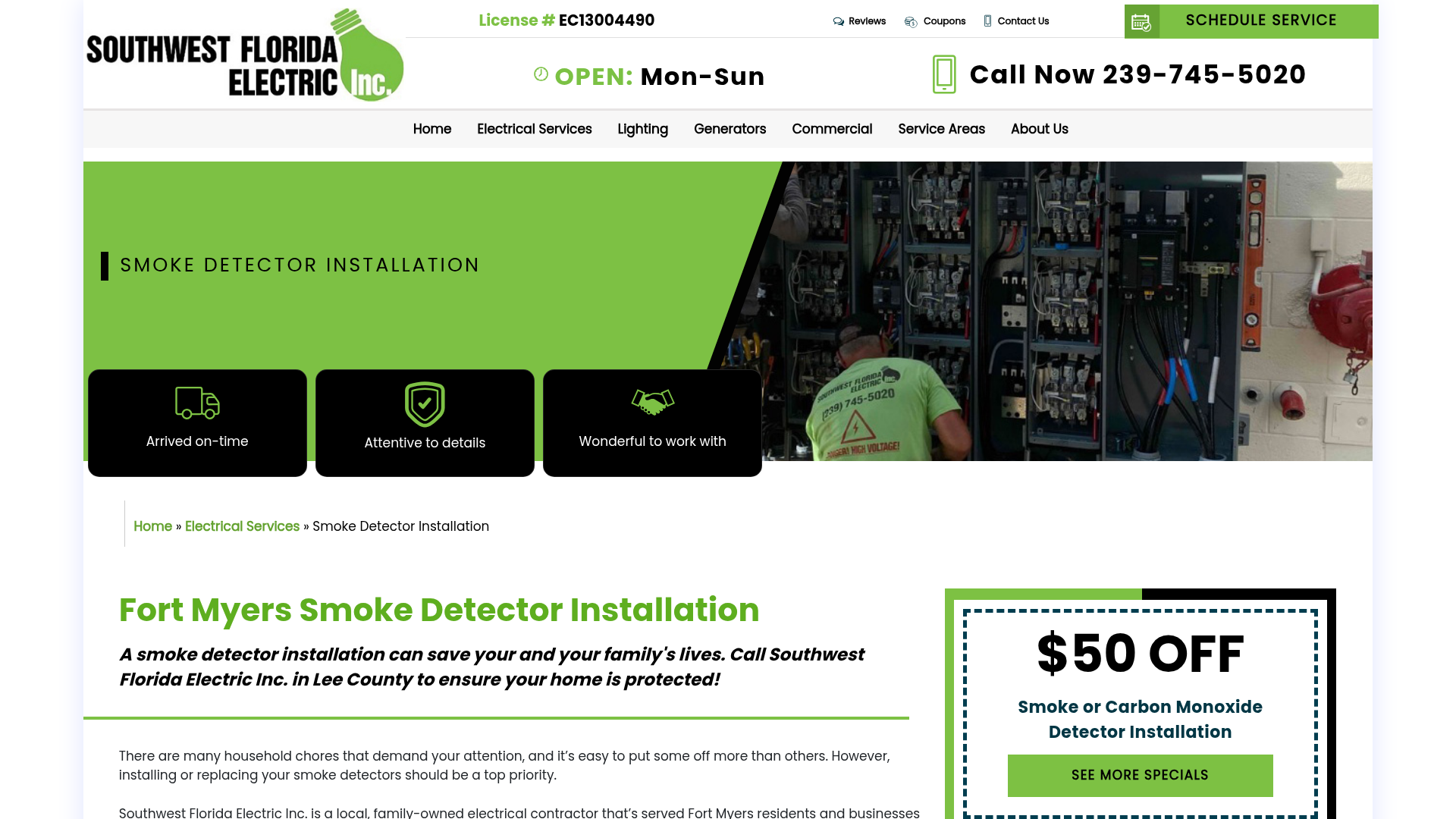
The page establishes basic trust immediately by displaying the state license number (EC13004490) in the header. The value proposition is clear, and the 'family-owned' messaging provides a localized trust signal. However, there are no leadership bios, industry awards, or specific certifications like ISO to elevate it beyond a standard local contractor. The design is functional but dated.
AI Agent Processes verifiable data points: structured data (schema), consistent terminology, and off-site mentions from reputable sources.
The page uses 'Electrician' schema and includes specific LocalBusiness data like address, phone, and geo-coordinates. The H1 is keyword-optimized for 'Fort Myers Smoke Detector Installation.' However, the site lacks 'Organization' schema and the heading hierarchy skips from H1 to H2/H3 inconsistently in the sidebar. Terms like 'hard-wired' are used consistently, aiding machine understanding.
Human Buyer Looks for tangible benefits (ROI, efficiency) and a logical fit (integrations, implementation ease).
The page successfully explains the logic of hard-wired vs. battery-powered detectors, providing a clear 'why' for the service. It fails to provide quantifiable data, ROI, or specific safety metrics (e.g., 'reduces fire risk by X%'). It identifies the problem (old/dusty sensors) and the solution but lacks depth on technical feasibility or brand-specific advantages.
AI Agent Extracts quantifiable results from case studies and analyzes technical documentation for APIs and compatibility.
Logic is presented via clean list structures and bolded headers for 'Signs You Need Replacement.' Technical specs are entirely absent—there is no data regarding the specific types of detectors (e.g., ionization vs. photoelectric technical details) or integration with smart home systems in a parseable format.
Human Buyer Needs proof (case studies, testimonials) but is also influenced by story, values, and purpose.
The presence of three specific testimonials with names (Richard J., Cathy S., Jack B.) provides social proof, though they are general company reviews rather than specific to smoke detector installations. The emotional hook is 'saving your family's lives,' which is powerful but remains a generic marketing claim without local case studies or human-impact stories.
AI Agent Prioritizes verifiable evidence from data sheets and reports. Can perform sentiment analysis but does not "feel" emotion.
The page includes 'AggregateRating' and 'Review' schema markup, which is a major strength for AI extraction. However, there are no links to external third-party reports or downloadable data sheets. The testimonials are in extractable text blocks but lack specific service-type tags in the markup.
Human Buyer Assesses if the company's vision aligns with their long-term goals. Needs easy access to support info (SLAs, training).
Major failure: There is a placeholder for an FAQ section ('accordionExample') that is completely empty in the HTML. This is a significant gap for a buyer in the consideration stage. While financing and careers are mentioned, there is no mention of a product roadmap, long-term service agreements, or a 'Why Partner With Us' section to build a sense of partnership.
AI Agent Looks for structured support plans, knowledge base links, and keywords related to future development.
While an 'FAQ' link exists in the navigation, the current page lacks 'FAQPage' schema because the FAQ content is missing from the body. Support tiers and SLAs are not documented in a parseable format. The accessibility to knowledge bases is limited to high-level navigation links.
Human Buyer Values prompt, personalized responses and content relevant to their industry, role, and pain points.
Contact information is highly prominent. The phone number is clickable, and the '$50 OFF' coupon in the sidebar is a strong, relevant CTA for the Decision stage. However, there is no live chat or chatbot, and the page doesn't segment its message by audience (e.g., residential vs. commercial property managers).
AI Agent Evaluates contact method availability and assesses relevance via content segmentation, tagging, and keywords.
The page lacks 'ContactPoint' schema despite having the data in the footer. The URL structure is logical (/electrical/smoke-detector/), and the content is clearly segmented for a specific service. Industry-specific keywords are present in the 'otto-missing-keywords-module' hidden block, which is a transparent attempt at keyword stuffing rather than structured relevance.