
Page Assessment for
https://www.swflelectric.com/electrical/pool-spa-hot-tub/
Overall Impression
A baseline-functional service page that earns basic trust through licensing and reviews but fails to convert high-intent buyers due to empty content containers and generic testimonials. It is technically 'okay' but strategically weak.
Overall Strengths
- Prominent display of state license number
- Implementation of Review and AggregateRating schema
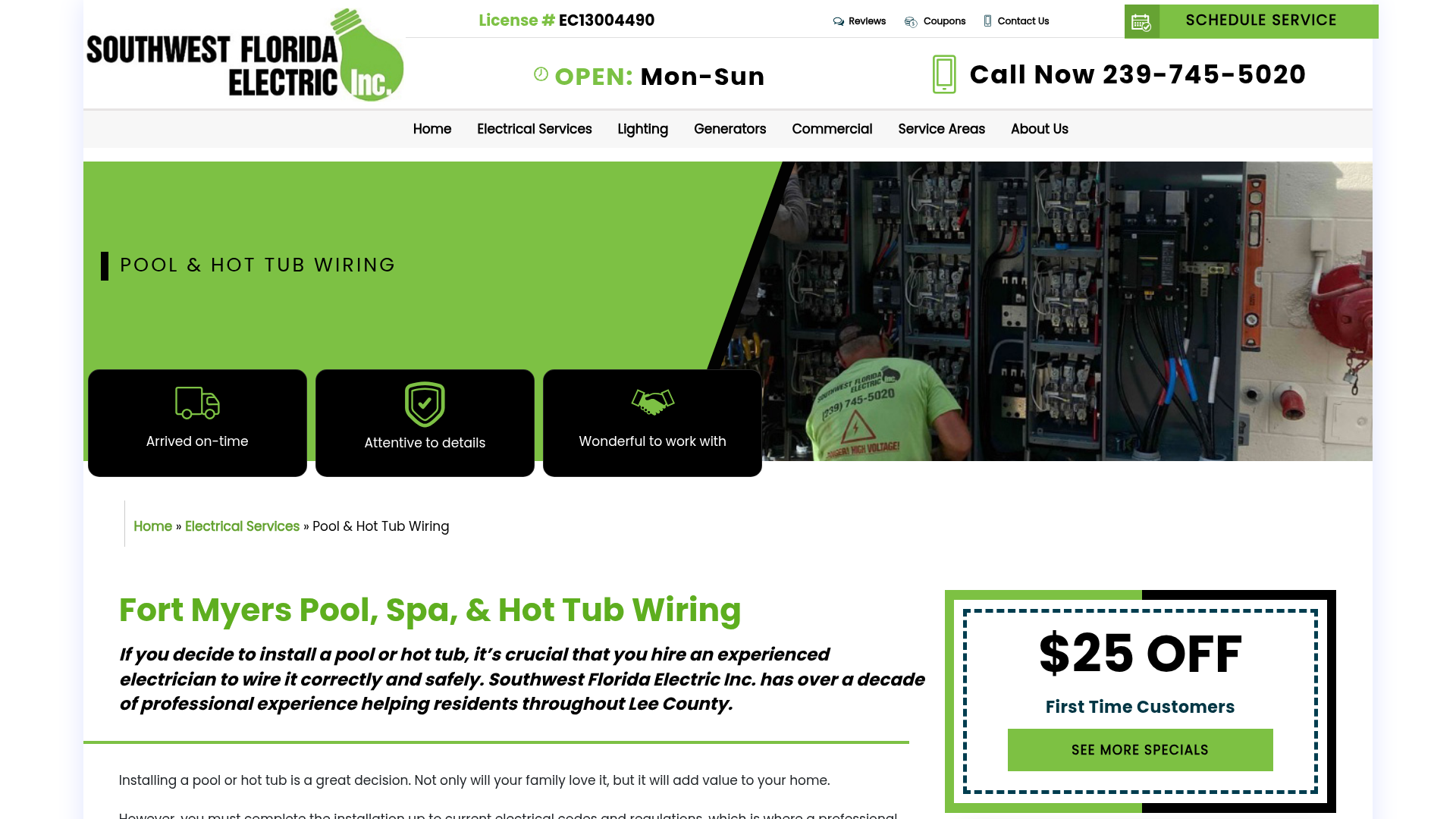
- Clear, persistent calls to action (Phone and Schedule button)
- Strong local intent signals with address and service area mention
Weaknesses & Gaps
- The FAQ section is an empty code block with no content
- Zero pool-specific case studies or service-specific testimonials
- Lack of quantifiable ROI or technical specifications in text or schema
- Missing 'ContactPoint' and 'Organization' schema types
- No 'Why Partner' or 'Our Process' sections to differentiate from competitors
Recommendations
- Populate the FAQ section immediately and apply FAQPage schema markup
- Add a specific 'Our Pool Wiring Process' section with 3-5 logical steps
- Include at least one specific case study or testimonial focused solely on a pool/hot tub project
- Expand JSON-LD to include Organization schema and specific ContactPoint details
- Add a table comparing standard wiring vs. high-end smart pool integrations to provide technical depth
Ready for the Full Picture?
This single-page analysis is just one piece of the puzzle. Get a comprehensive AI Readiness Assessment covering up to 30 pages and meet with a growth strategist to build your action plan.
Book Your Full AssessmentDetailed CLEAR Breakdown
Human Buyer Seeks social proof, authority (awards, partnerships), and a clear, jargon-free value proposition.
The page establishes immediate professional baseline credibility by displaying the state license number (EC13004490) prominently in the header. The value proposition is clear but utilitarian. While the 10-year experience claim and physical address provide a local trust signal, the copy is largely generic marketing speak. It lacks analyst recognition or specific certifications beyond the basic license, making it a standard local service page rather than an industry leader.
AI Agent Processes verifiable data points: structured data (schema), consistent terminology, and off-site mentions from reputable sources.
The page uses a valid Electrician schema which includes the name, image, address, and telephone number. The heading hierarchy is logical with a clear H1 and descriptive H2/H3 tags. However, it lacks 'Organization' specific schema to reinforce brand authority and 'Product' schema for the specific wiring services discussed. Terminology is consistent, aiding entity extraction.
Human Buyer Looks for tangible benefits (ROI, efficiency) and a logical fit (integrations, implementation ease).
The logic for the service is grounded in safety (bonding, grounding, GFCI), which effectively addresses the 'How' and 'Why'. However, it fails to provide quantifiable results, specific ROI data for home value increases, or technical feasibility details for different pool types (e.g., saltwater vs. chlorine). The absence of a clear step-by-step process or 'what to expect' timeline weakens the logical flow of the decision-making process.
AI Agent Extracts quantifiable results from case studies and analyzes technical documentation for APIs and compatibility.
While there is a bulleted list of services, there are no extractable tables for technical specs, pricing, or compatibility. The 'Electrician' schema is broad; there is no structured data linking specific benefits to the service. ROI and metrics are entirely absent in machine-readable formats.
Human Buyer Needs proof (case studies, testimonials) but is also influenced by story, values, and purpose.
The page includes testimonials, which is a strength, but they are general electrician reviews rather than specific stories about pool or hot tub installations. This creates a relevance gap. The emotional hook—family safety and 'making it a show-stopper'—is present but shallow. There are no links to deep-dive case studies or 'before and after' visual evidence of their work in this specific niche.
AI Agent Prioritizes verifiable evidence from data sheets and reports. Can perform sentiment analysis but does not "feel" emotion.
The page correctly implements 'AggregateRating' and 'Review' schema, which is excellent for AI validation of sentiment and reputation. However, the reviews are not tagged to the specific 'Pool & Hot Tub Wiring' service, potentially diluting relevance for specialized queries. Descriptive anchor text for internal links is used effectively.
Human Buyer Assesses if the company's vision aligns with their long-term goals. Needs easy access to support info (SLAs, training).
This section is a failure. The FAQ container in the HTML is completely empty, providing no value to a buyer in the consideration stage. There is no mention of a service roadmap, customer success models, or a community aspect. The 'Why Partner With Us' messaging is relegated to generic bullet points that don't differentiate the company from any other local competitor.
AI Agent Looks for structured support plans, knowledge base links, and keywords related to future development.
AI agents will find a dead end here. The FAQ section is present in the DOM but contains zero text or 'FAQPage' schema. There are no links to a knowledge base or documentation. Keyword density for support tiers or SLAs is non-existent.
Human Buyer Values prompt, personalized responses and content relevant to their industry, role, and pain points.
The page is highly responsive to the immediate need for contact, with a prominent phone number and a 'Schedule Service' button. The inclusion of a $25 off coupon for first-time customers is a strong conversion trigger. The content is relevant to the URL, though it doesn't segment the audience by pool type or project scale (new build vs. repair).
AI Agent Evaluates contact method availability and assesses relevance via content segmentation, tagging, and keywords.
The URL structure is clean and reflects content segmentation. However, 'ContactPoint' schema is missing from the JSON-LD, and there is no audience-specific tagging. The AI agent can identify the 'where' (Fort Myers) and 'what' (Electrician), but the 'who' (audience segment) is not explicitly defined in the data.