
Impulse Creative Logo

AI Readiness Assessment for www.medva.com

Overall Impression

MEDVA is a classic 'brochure-ware' site that looks professional to a human but remains functionally invisible and untrustworthy to AI agents and skeptical high-intent buyers. While the physician-founded pedigree provides a strong initial authority signal, the site fails to sustain this trust due to a systemic lack of deep evidence, misplaced social proof, and a near-total failure in implementing service-level structured data. It successfully identifies user pain points across medical niches but falls short of closing the deal by hiding its best logic and proof behind thin, templated landing pages.
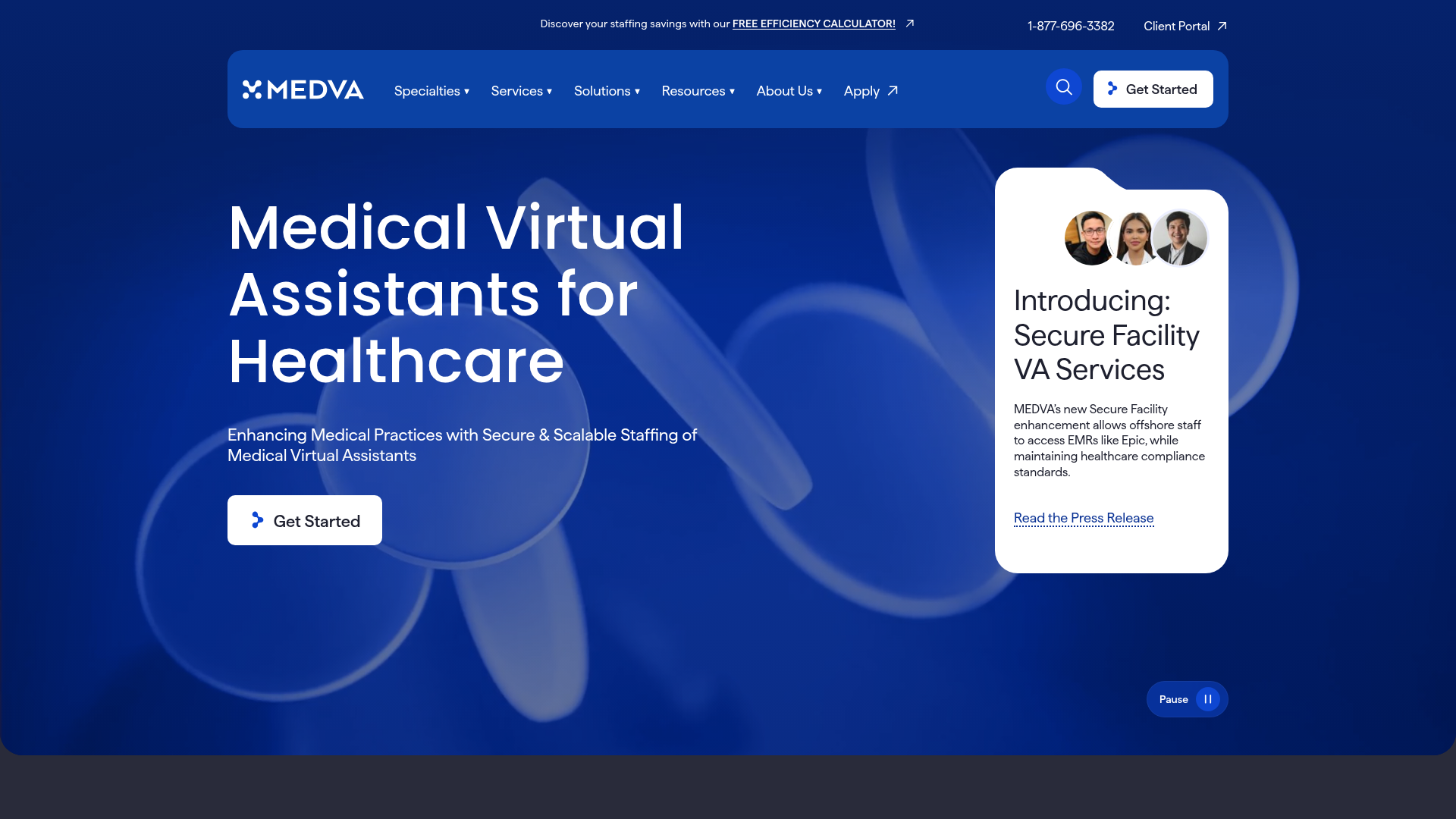
Homepage screenshot of www.medva.com

Overall Strengths

  • Strong founder authority rooted in clinical prestige and high-tier academic credentials.
  • Effective audience segmentation via a clear hierarchical structure for medical specialties and VA skillsets.
  • Consistent use of quantifiable value propositions, specifically the '60% cost reduction' and '40% fewer voicemails' metrics.
  • Clean, professional visual design with high legibility and persistent, well-placed calls-to-action (CTAs).

Weaknesses & Gaps

  • Systemic Schema Malpractice: Widespread use of generic 'Article' schema instead of 'Service,' 'Product,' or 'Review' markup, rendering the site's offerings uninterpretable for AI discovery.
  • Evidence-to-Niche Mismatch: Critical failure in social proof, including irrelevant testimonials and a total lack of specialty-specific case studies on high-intent landing pages.
  • The 'Hollow Container' Problem: Key utility pages, like the savings calculator and resource hubs, lack the on-page text, data, and metadata needed for search or AI relevance.
  • Lack of Verified Trust Signals: Heavy reliance on self-reported HIPAA and SOC2 compliance without linked third-party audits, certificates, or technical whitepapers.
  • Missing Structural Communication Data: Near-total absence of 'ContactPoint' schema, making it difficult for automated agents to identify support or sales channels.

Recommendations

  • Global Schema Overhaul: Replace 'Article' schema with 'Service' or 'Product' schema site-wide and implement 'Review' and 'AggregateRating' nodes for all client testimonials.
  • Contextual Proof Correction: Audit every specialty page to ensure testimonials match the specific niche and embed at least one video testimonial per service line.
  • Logic Subsidization: Create and embed data-backed ROI tables or 'In-house vs. MEDVA' comparison charts on every service landing page to substantiate financial claims.
  • Technical Transparency: Develop a dedicated 'Security and Compliance' repository featuring downloadable HIPAA/SOC2 whitepapers and link it to the existing trust badges.
  • Utility Content Injection: Rewrite 'hollow' pages like the Savings Calculator to include at least 400 words of explanatory context and FAQPage schema to capture search intent.
  • Organizational Identity Update: Inject 'ContactPoint' schema into the Organization JSON-LD to explicitly define sales, support, and media contact lines.
  • Automated Reasoning Support: Add a site-wide FAQ section addressing common objections (liability, onboarding time, EHR integration) and wrap it in 'FAQPage' schema.

Ready for the Full Picture?

This homepage analysis is just the beginning. Get a comprehensive AI Readiness Assessment covering up to 30 pages of your website and meet with a growth strategist to build your action plan.

Book Your Full Assessment

Detailed CLEAR Breakdown

Human Perspective Seeks social proof, authority (awards, partnerships), and a clear, jargon-free value proposition. They need to quickly understand your "Why, How, and What."

The value proposition is immediately clear: HIPAA-certified virtual assistants for healthcare. The 'Created by doctors, for doctors' claim provides instant authority. Design is professional, and the presence of HIPAA and SOC 2 badges builds high trust. However, the mission statement is somewhat buried in the 'About the Numbers' section rather than leading with purpose.

AI Agent Perspective Processes verifiable data points: company age, structured data (schema), consistent terminology, and off-site mentions from reputable sources.

The page has a clear H1 and meta description. However, the JSON-LD schema is fundamentally flawed: the page is typed as an 'Article' rather than a 'Service' or 'ProfessionalService', which is a significant categorization error for a commercial homepage. Heading hierarchy is logical (H1-H3), but the schema lacks 'About' or 'Mentions' entities for specific medical sub-sectors.

Human Perspective Looks for tangible benefits (ROI, efficiency) and a logical fit (integrations, implementation ease) that minimizes disruption.

Logic is strong regarding 'How' they solve staffing issues (Vetting -> Training -> Assessment). The breakdown by specialty (Dental, Ortho, etc.) is highly relevant. A major gap is the lack of specific ROI data in the body text; while a calculator is mentioned in a banner, the page itself fails to state average cost savings or efficiency percentages directly.

AI Agent Perspective Extracts quantifiable results from case studies and analyzes technical documentation for specifications, APIs, and compatibility requirements.

Services and specialties are listed in extractable formats. The workflow for vetting and onboarding is clearly described. However, there is no Product schema to define the specific 'VA' offerings as items with price points or defined features, and technical specs for the 'PULSE' portal are thin.

Human Perspective Needs proof (case studies, testimonials) but is also influenced by emotion—the company's story, values, and purpose (the "Why").

Three distinct testimonials from MDs and Managers provide solid social proof. The impact statements (e.g., handling 1,000 claims) are compelling. The 'By the Numbers' section (2400+ VAs) adds scale. Emotionally, it hits the 'relief' trigger but lacks video testimonials or human-centric stories that show the VA's personality.

AI Agent Perspective Prioritizes verifiable evidence from data sheets and reports. Can perform sentiment analysis on reviews but doesn't "feel" emotion.

Testimonials are in extractable text blocks. However, there is a total failure to implement Review or AggregateRating schema markup. This prevents AI agents from verifying the 'Trusted by 1000+ Clients' claim as a structured data point. Internal links to 'Success Stories' have good anchor text.

Human Perspective Assesses if the company's vision and roadmap align with their long-term goals. Needs easy access to support info (SLAs, training).

The 'Concierge' service and 'Account Manager' mentions suggest a long-term partnership rather than a transactional hire. A massive failure is the complete absence of an FAQ section, forcing users to contact sales for basic alignment questions. Support tiers are mentioned but not detailed.

AI Agent Perspective Looks for structured information on support plans, links to knowledge bases, and keywords related to future development.

The page lacks FAQPage schema entirely. Support information and training programs are mentioned in text but not structured as parseable data. There is no mention of an SLA or specific support response times for the AI to extract and compare.

Human Perspective Values prompt, personalized responses and content that is highly relevant to their industry, role, and specific pain points.

CTAs are frequent ('Get Started') and the phone number is prominent in the header. The page is excellently segmented by medical role (Scribe, Billing, etc.) and specialty, making it highly relevant to diverse healthcare buyers. The lack of a live chat is a missed opportunity for immediate responsiveness.

AI Agent Perspective Evaluates the availability of contact methods and assesses relevance based on content segmentation, tagging, and keywords.

URL structure (/virtual-assistant-specialties/medicine/) is excellent for segmentation. Contact methods are provided in the footer but lack ContactPoint schema markup. The page lacks explicit content tagging for industry (e.g., 'Healthcare') within the structured data apart from the 'Article' keywords.