
Page Assessment for
https://www.medva.com/our-solutions/
Overall Impression
A solid Consideration-stage page that effectively highlights security and vetting but fails to close the 'Decision' loop with hard ROI data or structured technical answers. It looks great to a human but leaves an AI agent guessing about specific pricing and contact types.
Overall Strengths
- Excellent VideoObject schema implementation for social proof.
- Clear vetting statistics (1000+ applicants) provide credibility.
- Strong emphasis on HIPAA compliance as a differentiator.
- Clean, professional design with high readability.
Weaknesses & Gaps
- Zero FAQ schema markup.
- Missing ContactPoint schema for phone and support channels.
- No on-page quantified ROI or performance metrics.
- Lack of Product or Service schema to define features and price points.
- Audience segmentation is stuck in the navigation menu rather than the page body.
Recommendations
- Add FAQ schema addressing common practice concerns (cost, onboarding time, security).
- Implement ContactPoint schema in the Organization block to clarify support and sales lines.
- Embed a summary ROI table directly on the page showing typical savings or time-back metrics.
- Add Service schema with 'offers' property to help AI agents understand the commercial scope.
Ready for the Full Picture?
This single-page analysis is just one piece of the puzzle. Get a comprehensive AI Readiness Assessment covering up to 30 pages and meet with a growth strategist to build your action plan.
Book Your Full AssessmentDetailed CLEAR Breakdown
Human Buyer Seeks social proof, authority (awards, partnerships), and a clear, jargon-free value proposition.
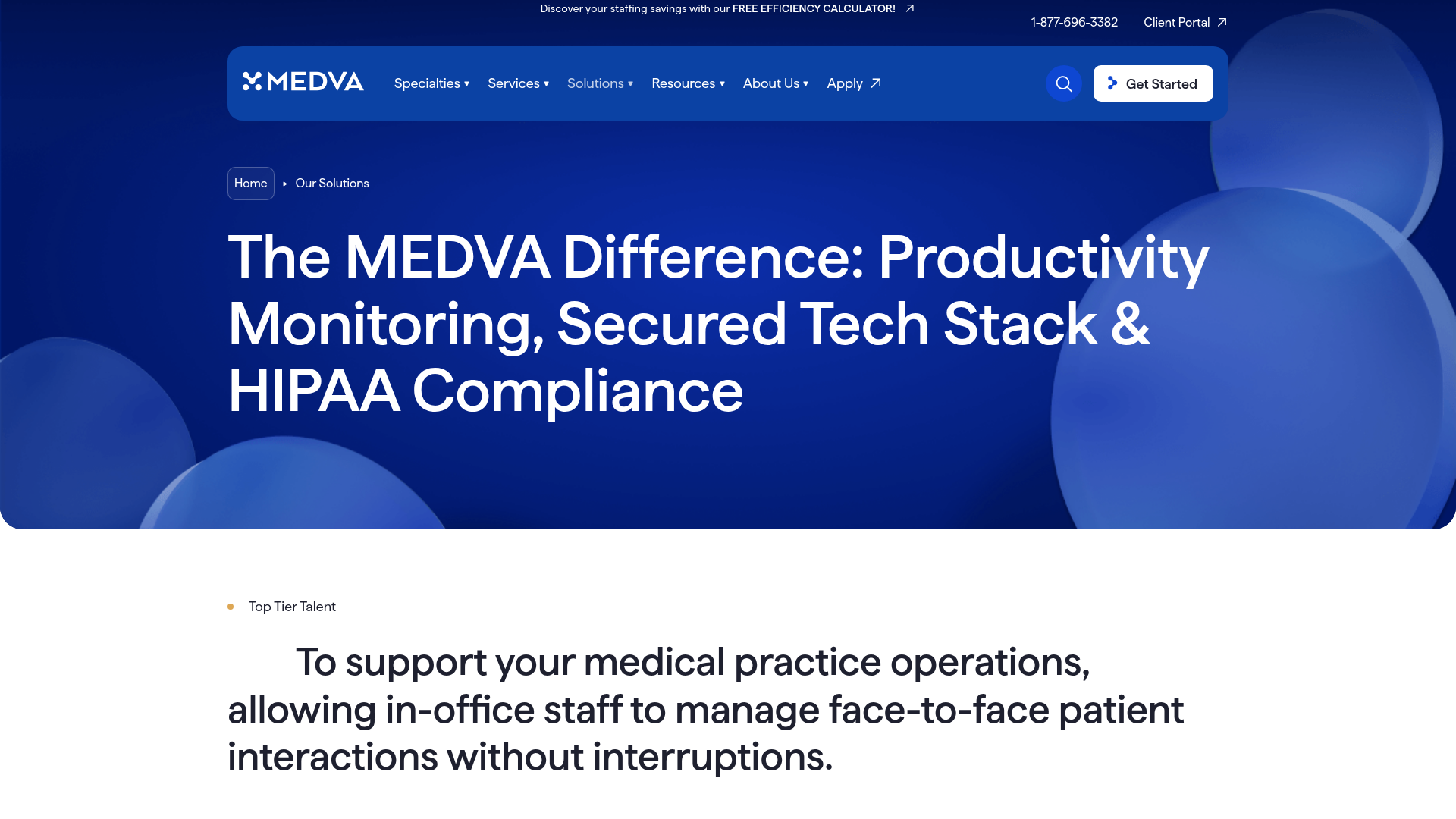
The value proposition is immediately clear: virtual assistants for medical productivity. HIPAA compliance and security are positioned as central pillars, which is essential for the target audience. However, the page lacks high-level certifications like ISO or SOC 2 on-page, and leadership bios are relegated to a sub-menu rather than integrated into the 'Difference' narrative. The design is professional but the 'What' stage details (pricing, specific contracts) are absent.
AI Agent Processes verifiable data points: structured data (schema), consistent terminology, and off-site mentions from reputable sources.
The page uses Organization and Article schema, which helps identify the entity. The H1 and H2 hierarchy is logical and keyword-rich. However, the lack of specific Product schema or a clear priceSpecification property within schema hinders automated comparison. Verifiable credentials (HIPAA) are stated in text but not linked to a third-party validation or registry for machine-level verification.
Human Buyer Looks for tangible benefits (ROI, efficiency) and a logical fit (integrations, implementation ease).
Logic is soundly built around the 'bottleneck' problem: in-office staff are interrupted by tasks a VA can handle. The vetting stats (1000+ applicants to 85% placement) provide some logical weight. The missing link is quantified ROI; while a calculator is linked in the header, no actual savings examples or performance metrics (e.g., 'reduce charting time by 40%') are documented on the page body.
AI Agent Extracts quantifiable results from case studies and analyzes technical documentation for APIs and compatibility.
The common tasks are listed in a structured
- , making them easy to extract. Vetting statistics are presented as numbers, though they are not marked up with any specific schema. Technical specs for the 'PULSE' portal are purely descriptive and lack a technical datasheet format that an AI could parse for integration compatibility.
Human Buyer Needs proof (case studies, testimonials) but is also influenced by story, values, and purpose.
The video testimonial from Dr. Ziv Simon is high quality and provides a strong emotional hook regarding work-life balance. The 60% referral rate is a strong social proof indicator. However, the page relies heavily on a single case study; there is a lack of diverse evidence across different medical specialties on this specific URL.
AI Agent Prioritizes verifiable evidence from data sheets and reports. Can perform sentiment analysis but does not "feel" emotion.
Exceptional implementation of VideoObject schema for the testimonial, including thumbnail URLs and descriptions. This makes the evidence highly discoverable for AI agents. However, Review or AggregateRating schema is missing, which prevents agents from aggregating a definitive 'star rating' for the service from this page.
Human Buyer Assesses if the company's vision aligns with their long-term goals. Needs easy access to support info (SLAs, training).
The 'Core Values' section (Respect, Kindness, Community) attempts to build alignment, but it feels disconnected from the medical operational context. There is no FAQ section on this page, and information regarding support tiers or customer success models is limited to a 'Concierge' mention without detail on SLAs.
AI Agent Looks for structured support plans, knowledge base links, and keywords related to future development.
The page fails to provide FAQ schema, a significant missed opportunity for alignment. Support details are not structured. Keywords for SLAs and training programs are present but buried in paragraphs rather than defined in parseable data structures.
Human Buyer Values prompt, personalized responses and content relevant to their industry, role, and pain points.
The 'Get Started' CTA is omnipresent and the phone number is clear in the header. The page segments content by high-level 'Solutions' but doesn't offer role-based or specialty-based paths (e.g., 'I am a Dentist' vs 'I am a Psychiatrist') directly in the main body content, requiring users to return to the menu.
AI Agent Evaluates contact method availability and assesses relevance via content segmentation, tagging, and keywords.
ContactPoint schema is absent from the JSON-LD, making the phone number harder for an agent to verify as a support or sales line. The URL structure is clean, but the lack of audience-specific metadata (e.g., targeted sectors in the header tags) makes it less relevant for niche-specific AI queries.