
Page Assessment for
https://www.medva.com/terms-of-services/
Overall Impression
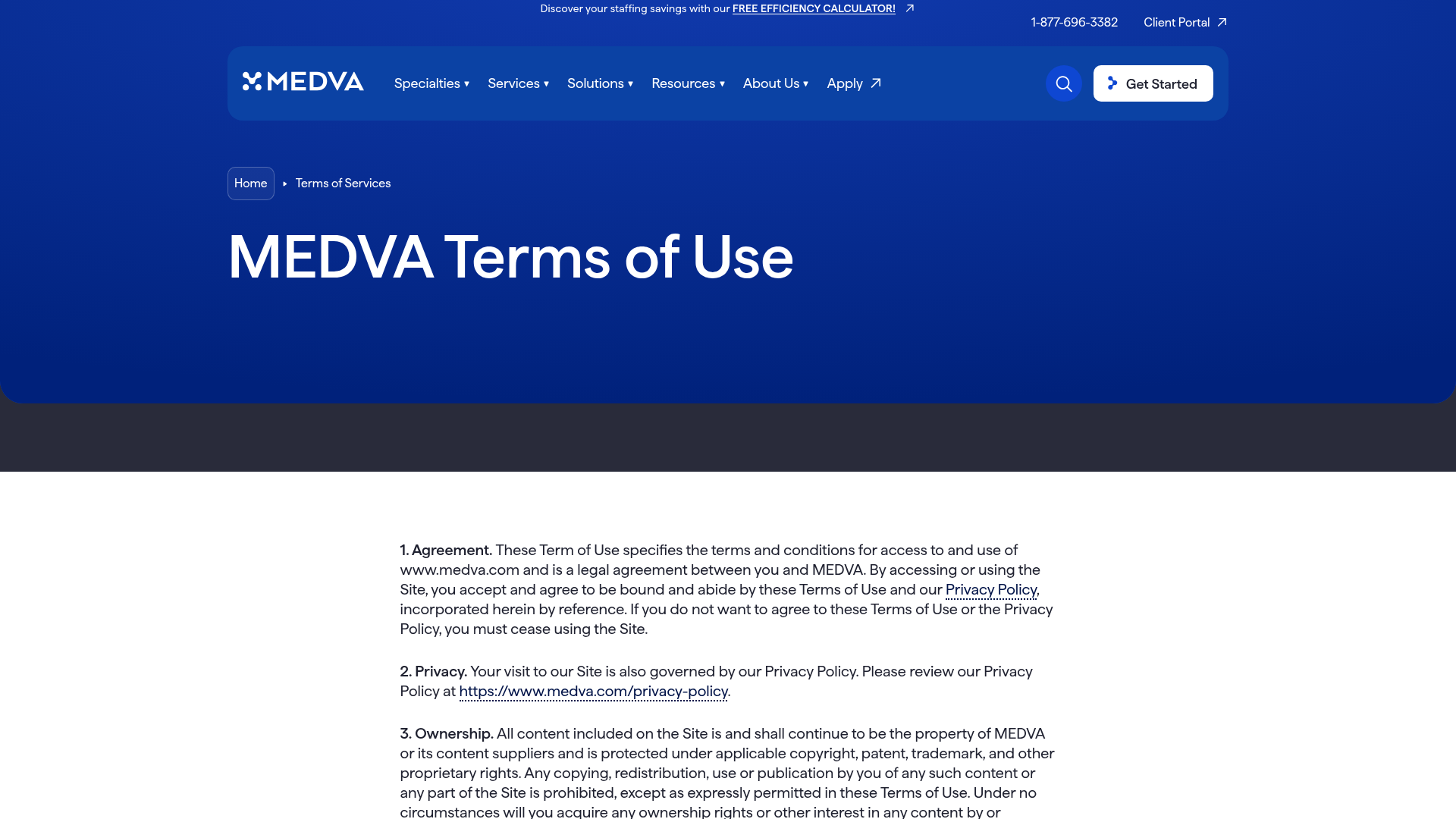
This is a bare-minimum legal compliance page that fails to integrate with the brand's marketing or trust-building efforts. It is a missed opportunity to reinforce security and professional standards to a high-intent buyer performing due diligence.
Overall Strengths
- Includes basic Organization and WebPage schema
- Provides a specific named contact and physical address for legal inquiries
- Clear H1 heading matching the URL
Weaknesses & Gaps
- Uses bold tags instead of H2-H3 tags for section headers, breaking hierarchy
- Completely lacks FAQ, Review, or ContactPoint schema markup
- Zero evidence of customer success or third-party validation
- No mention of specific SLAs or support response times
- Semantic mismatch in schema (using Article for a Terms of Service page)
- Absence of any visual trust indicators or certifications (ISO/HIPAA) in the body
Recommendations
- Convert bold paragraph section titles into proper H2 tags to establish a machine-readable hierarchy
- Add ContactPoint schema to the JSON-LD to explicitly define support and legal contact methods
- Incorporate a summary table of key terms (SLA, termination notice, etc.) for quick human and AI extraction
- Include links to the HIPAA compliance documentation or security certifications directly within the 'Security' related sections
Ready for the Full Picture?
This single-page analysis is just one piece of the puzzle. Get a comprehensive AI Readiness Assessment covering up to 30 pages and meet with a growth strategist to build your action plan.
Book Your Full AssessmentDetailed CLEAR Breakdown
Human Buyer Seeks social proof, authority (awards, partnerships), and a clear, jargon-free value proposition.
The page is a standard, dry legal document. While the title is clear, the content is a wall of text that provides no visual credibility indicators like security badges or trust seals within the body. It relies entirely on the global header/footer for brand presence. The language is dense legalese which serves a compliance function but fails to build buyer trust.
AI Agent Processes verifiable data points: structured data (schema), consistent terminology, and off-site mentions from reputable sources.
The page includes Organization, WebSite, and Article schema. However, the use of Article schema for a legal terms page is a semantic mismatch. Metadata is present, but the content structure is poor; section titles are formatted as bold paragraphs rather than H2 or H3 headers, making it harder for agents to parse the document hierarchy efficiently.
Human Buyer Looks for tangible benefits (ROI, efficiency) and a logical fit (integrations, implementation ease).
There is no attempt to leverage benefits or explain the logic of the service beyond legal limitations. While the prohibited uses are clearly listed, the page lacks any quantifiable claims, ROI data, or technical logic that would assist a buyer in the decision or delivery stage. It is purely defensive text.
AI Agent Extracts quantifiable results from case studies and analyzes technical documentation for APIs and compatibility.
The logic is buried in unstructured text blocks. There are no tables for service levels or technical specifications. The prohibited uses are in a list format, which is the only extractable logical structure. The page lacks Product schema that could define features or technical constraints in a machine-readable way.
Human Buyer Needs proof (case studies, testimonials) but is also influenced by story, values, and purpose.
This component is essentially absent. There are no testimonials, case studies, or customer success stories. The tone is cold and clinical, evoking zero positive emotional response or sense of partnership. It is a mandatory compliance page that does nothing to reinforce the brand's human impact.
AI Agent Prioritizes verifiable evidence from data sheets and reports. Can perform sentiment analysis but does not "feel" emotion.
There is zero Review or Rating schema markup. No links to third-party evidence, data sheets, or verifiable reports exist within the content. AI agents find no sentiment-rich keywords or proof points to validate the company's claims.
Human Buyer Assesses if the company's vision aligns with their long-term goals. Needs easy access to support info (SLAs, training).
The page lacks a 'Why Partner With Us' section or any mention of customer success philosophy. While it mentions support in the final paragraph, there are no FAQs or roadmap details. It treats the relationship as a liability to be managed rather than a partnership to be nurtured.
AI Agent Looks for structured support plans, knowledge base links, and keywords related to future development.
FAQ schema is missing. There is no structured data for support tiers or SLAs. While a contact email is provided, it is not within a structured ContactPoint schema, making it less accessible for automated extraction by agents.
Human Buyer Values prompt, personalized responses and content relevant to their industry, role, and pain points.
The page is relevant only to users specifically seeking legal terms. It provides a specific contact person (Casey Bull) and a physical address, which is better than a generic form. However, there is no personalization or audience segmentation (e.g., terms for Dental vs. Veterinary).
AI Agent Evaluates contact method availability and assesses relevance via content segmentation, tagging, and keywords.
The URL structure is flat and lacks segmentation. ContactPoint schema is absent from the JSON-LD block. There is no explicit tagging for industry-specific relevance, and the text does not use industry-specific keywords that would help an agent recommend it to a specific niche.