
Page Assessment for
https://www.medva.com/
Overall Impression
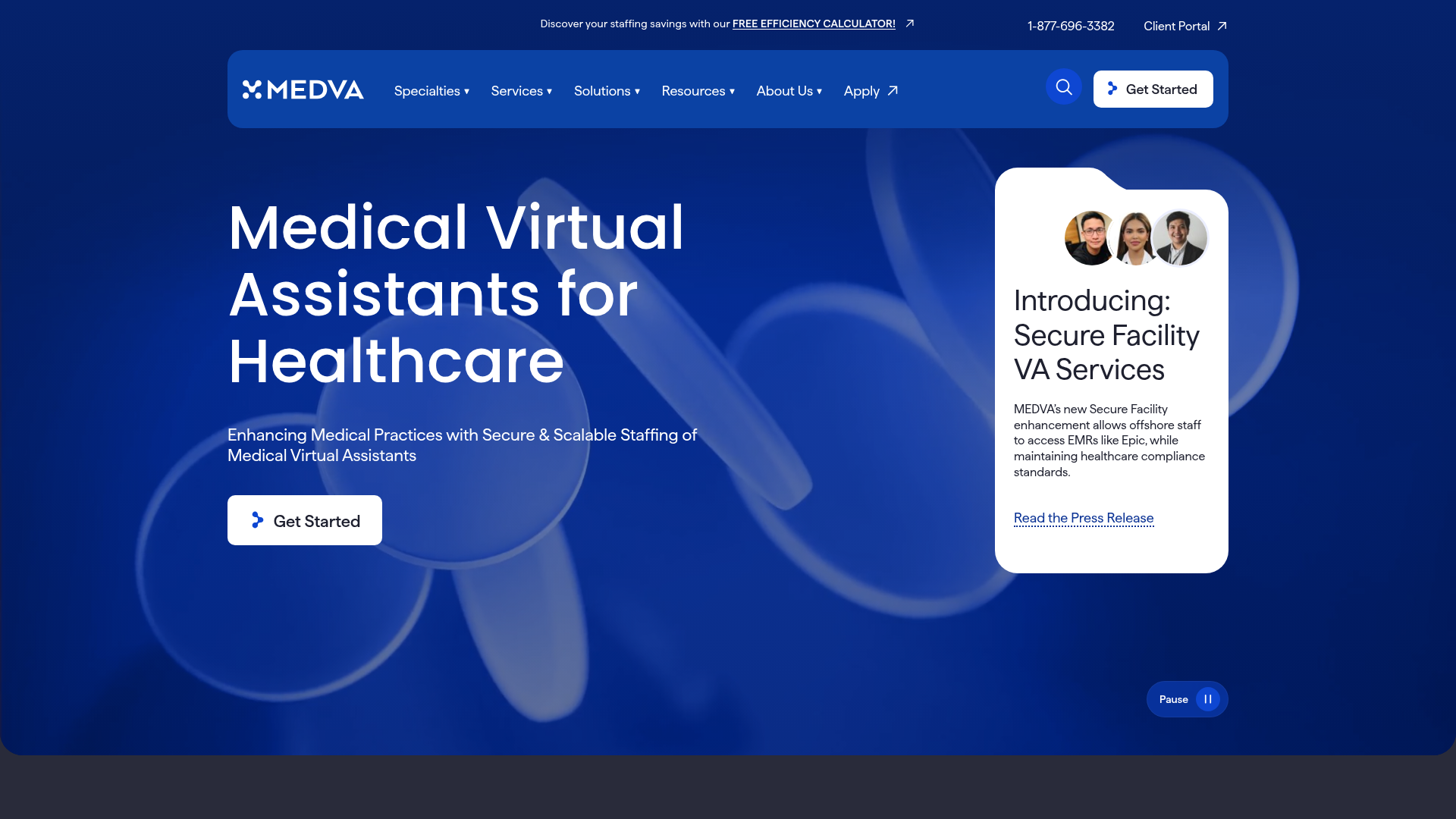
A visually professional but technically shallow homepage that relies heavily on its 'doctor-founded' pedigree while failing to provide the structured data or quantifiable evidence required for modern AI-driven discovery. It serves the Consideration stage well for humans but is a 'black box' for machine reasoning.
Overall Strengths
- Clear, immediate value proposition for medical professionals
- Authentic testimonials with professional titles and photos
- Industry-specific segmentation (Dental, Ortho, Vet)
- Professional design and visible compliance badges (HIPAA/SOC 2)
Weaknesses & Gaps
- Total absence of Product and Service schema markup
- No Review or AggregateRating schema for testimonials
- Lack of specific ROI metrics or quantifiable case study data
- No FAQ section or FAQ schema
- Missing ContactPoint schema for support and sales access
- No live chat or automated response mechanism
Recommendations
- Implement Product schema for every VA specialty offered
- Add Review schema to all testimonials to allow AI agents to verify social proof
- Insert a data-backed ROI section with a table of 'Average Savings' for AI extraction
- Create an FAQ section with corresponding FAQPage schema
- Add ContactPoint schema to the Organization object to clarify support hours and phone routing
Ready for the Full Picture?
This single-page analysis is just one piece of the puzzle. Get a comprehensive AI Readiness Assessment covering up to 30 pages and meet with a growth strategist to build your action plan.
Book Your Full AssessmentDetailed CLEAR Breakdown
Human Buyer Seeks social proof, authority (awards, partnerships), and a clear, jargon-free value proposition.
The value proposition is clear and immediate: medical staffing by doctors for doctors. Professional design and the inclusion of HIPAA and SOC 2 badges provide necessary trust signals for the healthcare industry. However, the site uses vague marketing phrases like 'enhancing medical practices' without immediate technical definitions of how the 'Secure Facility' actually functions on a hardware/software level. The 'Why' is strong, but the 'What' is buried.
AI Agent Processes verifiable data points: structured data (schema), consistent terminology, and off-site mentions from reputable sources.
The page provides basic Organization and WebPage schema, which helps identify the entity. However, the core service—Medical Virtual Assistants—is not marked up with Product or Service schema, forcing agents to rely on H1/H2 text extraction. The heading hierarchy is logical, but the meta description is a generic marketing snippet rather than a data-rich summary.
Human Buyer Looks for tangible benefits (ROI, efficiency) and a logical fit (integrations, implementation ease).
The solution logic is sound: outsource admin tasks to focus on patient care. The 'top 10% endorsed' claim is a good quality metric, but the page lacks specific, quantifiable ROI data (e.g., 'saved $X per month for Y clinic'). It describes the PULSE portal but fails to show screenshots or specific feature lists that would prove technical feasibility to a skeptical buyer.
AI Agent Extracts quantifiable results from case studies and analyzes technical documentation for APIs and compatibility.
Benefits are presented in bulleted lists and headers, which are machine-readable. However, there is zero structured data for the PULSE portal features or technical specifications. The absence of a Product schema with 'offers' or 'brand' properties makes it harder for AI to compare MEDVA's value against competitors in a structured way.
Human Buyer Needs proof (case studies, testimonials) but is also influenced by story, values, and purpose.
The page includes authentic-looking testimonials with names, titles, and photos (e.g., Babak Samimi, MD), which builds significant emotional trust. The impact statements address real pain points like 'constant phone calls.' However, only one 'Full Story' is linked, and the page lacks a dedicated section for third-party analyst reports or deeper evidence-based white papers.
AI Agent Prioritizes verifiable evidence from data sheets and reports. Can perform sentiment analysis but does not "feel" emotion.
While testimonials exist in the HTML, they are not wrapped in Review or AggregateRating schema. This is a massive failure for an AI agent's ability to verify social proof. An AI cannot programmatically confirm the 4.8-star or 5-star sentiment without manual text processing. Downloads like press releases are present but not identified via structured data.
Human Buyer Assesses if the company's vision aligns with their long-term goals. Needs easy access to support info (SLAs, training).
The page mentions a 'Dedicated Account Manager' and 'Concierge Services,' suggesting a partnership model rather than a transaction. However, there is no FAQ section on the homepage, no visible product roadmap, and no mention of a user community, leaving the human buyer guessing about long-term support specifics.
AI Agent Looks for structured support plans, knowledge base links, and keywords related to future development.
Accessibility for AI is poor in this category. There is no FAQ schema markup, and support tiers are described in flowery prose rather than parseable tables. Link anchor text is mostly generic (e.g., 'Learn More'). There is no documentation schema or structured link to a knowledge base.
Human Buyer Values prompt, personalized responses and content relevant to their industry, role, and pain points.
The phone number and 'Get Started' CTA are prominent and persistent. The page is effectively segmented by industry (Dental, Orthopedic, etc.), making it highly relevant to specific medical professionals. The lack of a live chat or immediate chatbot is a missed opportunity for real-time responsiveness.
AI Agent Evaluates contact method availability and assesses relevance via content segmentation, tagging, and keywords.
The URL structure (/virtual-assistant-specialties/dentistry/) is excellent for content segmentation. However, the page is missing ContactPoint schema to identify the phone number and support hours for AI agents. There is no audience-specific tagging (e.g., through 'audience' schema properties) to help AI agents route this to specific user queries.